
As the snow finally melts across Ontario and the days start getting longer, most homeowners begin thinking about spring cleaning, landscaping, and opening their windows. However, there is one critical spring task that often gets completely forgotten until it is too late: scheduling your annual AC tune-up.
In the Greater Toronto Area, your air conditioning system sits completely idle outside for six to seven months. It gets buried in snow, encased in ice, and battered by freezing rain. Then, the first major humid heatwave of May or June hits, and you expect that same machine to turn on instantly and run at maximum capacity. Firing up a dormant, unchecked air conditioner is a recipe for seized motors, blown electrical components, and immediate system failure.
At Heat Flow HVAC, we operate as a leading HVAC company in the region, and every single summer, we see the same pattern. The first week the temperature hits 30 degrees Celsius, our phones ring off the hook with panicked homeowners dealing with a broken system. Almost all of these expensive emergency breakdowns could have been easily prevented with a simple, proactive AC tune-up in the spring.
In this comprehensive guide, we will pull back the curtain on exactly what a professional AC tune-up includes, why it is a smart financial decision, and how it protects your home comfort all summer long.
What Does a Professional AC Tune-Up Include?
A common misconception is that air conditioner maintenance just involves changing the indoor filter and wiping down the outside box. While changing your filter is crucial, a comprehensive AC tune-up performed by a licensed technician goes much deeper. It is a full diagnostic and restorative service designed to return your system to factory specifications.
Cleaning the Condenser Coils (Airflow is King)
The large unit sitting in your backyard is the condenser. Its primary job is to release the heat that was absorbed from inside your house. To do this efficiently, the aluminum fins (coils) on the outside of the unit must be completely clear of debris.
In Toronto and Mississauga, late spring brings a massive wave of cottonwood fluff, pollen, and dust. This debris acts like a thick wool blanket over your air conditioner. If the coils are clogged, the heat gets trapped inside the unit. This forces the compressor to work twice as hard, drawing massive amounts of electricity and risking an overheating shutdown. During an AC tune-up, we use specialized, safe chemical cleaners and gentle water pressure to completely wash and clear these delicate coils.
Checking Refrigerant Levels (Freon)
Your air conditioner uses a chemical refrigerant to absorb and move heat. A healthy system never “consumes” or burns this refrigerant. If your system is low on cooling juice, it means you have a microscopic leak somewhere in the copper lines or the evaporator coil.
Running a system with low refrigerant is incredibly dangerous for the equipment. It leads to frozen coils and destroyed compressors. Testing the precise pressure and temperature of your refrigerant is a mandatory step in our service. Please note that handling refrigerants is heavily regulated to protect the environment. According to the Technical Standards and Safety Authority (TSSA), only certified and licensed professionals are legally allowed to test, handle, or recharge HVAC refrigerants in Ontario.
Testing Electrical Components and Capacitors
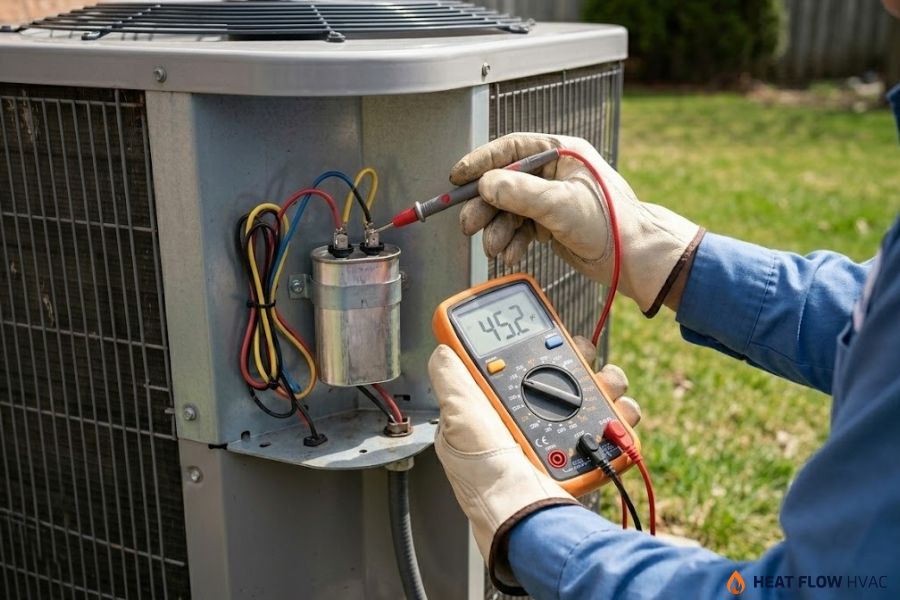
Electrical failures are the number one cause of sudden mid-summer breakdowns. Your outdoor unit contains several high-voltage components, but the most vulnerable is the dual-run capacitor. This part acts like a massive battery that stores electricity and gives the heavy compressor motor a “jolt” to help it start spinning.
Over time, extreme heat and frequent cycling cause these capacitors to degrade. A weak capacitor will cause the motor to struggle, run hot, and eventually burn out entirely. During an AC tune-up, we use a multimeter to measure the exact microfarad output of the capacitor. If it is weak, we can replace a $50 part on the spot, saving you from a $600 motor replacement later. If we find that a major electrical component has already failed during our inspection, we will guide you seamlessly into the AC repairing process.
Clearing the Condensate Drain Line
When your air conditioner cools the air, it also dehumidifies it. This process pulls gallons of water out of the indoor air every single day. This water drips into a drain pan and flows out through a PVC pipe called the condensate line.
Because this pipe is dark and constantly wet, it is the perfect breeding ground for mold, algae, and sludge. If this line clogs, the water will back up and overflow directly into your basement, ruining your furnace circuit board or your drywall. Flushing and vacuuming this line is a standard and vital part of spring maintenance.
Top 4 Reasons You Should Never Skip an AC Tune-Up
We understand that homeowners are hesitant to spend money on a system that seems to be working fine. However, viewing an AC tune-up as an expense is the wrong approach. It is an investment that pays for itself in several measurable ways.
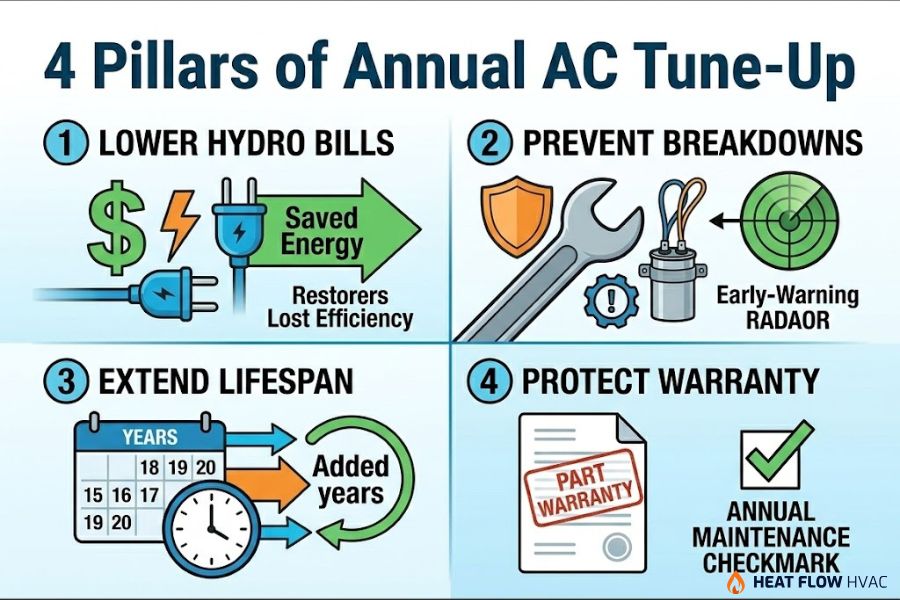
Factor 1: Lower Summer Hydro Bills
A neglected air conditioner is an inefficient air conditioner. When coils are dirty, parts are unlubricated, and airflow is restricted, the system has to run for much longer cycles just to reach the temperature set on your thermostat. This constant running causes your summer electricity bills to skyrocket. According to data from Natural Resources Canada, regular maintenance and tuning can restore lost efficiency and save you up to 15% on your cooling energy costs.
Factor 2: Preventing Expensive Breakdowns
The phrase “an ounce of prevention is worth a pound of cure” perfectly applies to HVAC systems. As mentioned earlier, catching a fraying wire, a loose fan belt, or a dying capacitor during a routine inspection is incredibly cheap to fix. If you ignore these warning signs, that small failing part will cause a chain reaction that destroys the most expensive components in the system. An AC tune-up acts as an early warning system for your home comfort.
Factor 3: Extending the Lifespan of Your Unit
A central air conditioning system is a major financial investment. Most modern units are designed to last 15 to 20 years if they are properly cared for. Conversely, a unit that never receives maintenance may fail in just 8 to 10 years due to the constant strain and overheating. By scheduling an annual AC tune-up, you are literally adding years to the life of your equipment. If your system is already over 15 years old and constantly struggling, it might be time to skip the maintenance and consult our experts for a modern, high-efficiency AC installation service.
Factor 4: Protecting Your Manufacturer Warranty
This is the most critical factor that many homeowners do not know about. Premium HVAC brands like Amana, Excalibur, Carrier, and Lennox provide excellent warranties, often covering parts for up to 10 years. However, if you read the fine print in your owner’s manual, those warranties strictly require proof of annual professional maintenance.
If your compressor fails in year six and you try to file a warranty claim, the manufacturer will ask for your service records. If you cannot prove that you have had regular maintenance, they have the right to void your warranty, leaving you to pay the entire replacement bill out of pocket.

When is the Best Time to Schedule an AC Tune-Up in Ontario?
Timing is everything when it comes to HVAC maintenance. The absolute best time to book your AC tune-up is in the “shoulder season” between late March and early May.
Here is why early spring is the ideal window:
- Availability: During March and April, HVAC technicians have more flexible schedules. You can book an appointment that fits perfectly into your day without waiting weeks.
- Beating the Heat: If we discover a problem during the tune-up, we have plenty of time to order parts and fix it before the first 30-degree day arrives.
- Instant Savings: Your system will be running at peak efficiency from the very first day you turn it on, ensuring your earliest hydro bills are as low as possible.
DIY Maintenance vs. Hiring a Professional HVAC Company
While an AC tune-up absolutely requires a licensed technician, there is still a partnership between the homeowner and the HVAC company. If you recently read our guide on what to do if you find your AC running not cooling, you know there are a few safe tasks you should handle yourself.
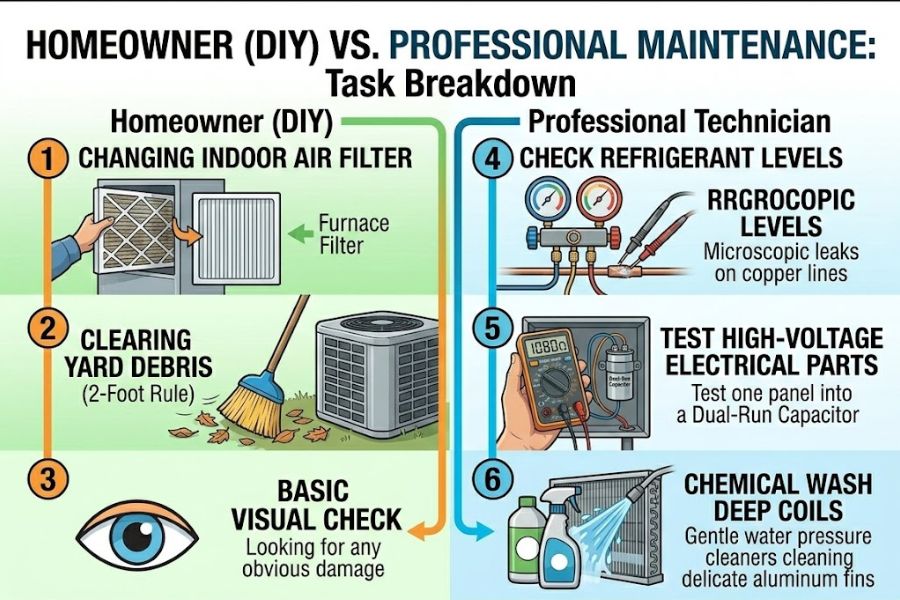
Here is a clear breakdown of what you should do versus what Heat Flow HVAC will do during your tune-up.
| Maintenance Task | Who Should Do It? | Why It Matters |
|---|---|---|
| Changing the Indoor Air Filter | Homeowner (Every 1 to 3 months) | Prevents frozen coils and maintains basic airflow. |
| Clearing Yard Debris (2-Foot Rule) | Homeowner (Spring & Summer) | Ensures the outdoor condenser has room to “breathe”. |
| Testing High-Voltage Electrical Parts | Professional Technician | Prevents electrical shock, fire hazards, and motor burnouts. |
| Checking Freon/Refrigerant Pressure | Professional Technician | Legally required by the TSSA to prevent environmental harm and system damage. |
| Chemical Washing of Deep Coils | Professional Technician | Removes baked-on dirt that a regular garden hose cannot touch. |
Book Your Expert AC Tune-Up in Toronto and the GTA
Do not wait until your house feels like a sauna to find out if your air conditioner survived the winter. By taking action now, you guarantee a cool, comfortable, and stress-free summer for you and your family.
At Heat Flow HVAC, our thorough AC tune-up process is designed to find small issues before they become massive headaches. Whether you are in Vaughan, Mississauga, or downtown Toronto, our licensed technicians are ready to prepare your system for the extreme Ontario heat.
Protect your investment and lower your summer hydro bills. Contact us today to schedule your comprehensive spring AC maintenance!