
Walking down to your basement to check the laundry, only to step into a cold puddle of water near your heating unit, is a terrible way to start the day. The panic sets in almost immediately. Is the furnace broken? Is it going to explode? How much is this going to cost?
Take a deep breath. While finding water around your furnace is definitely a sign that something is wrong, it does not always mean your entire heating system is failing. In fact, for many modern homes in Toronto and the GTA, a furnace leaking water is often a maintenance issue rather than a catastrophic breakdown. However, ignoring it can lead to damaged floorboards, mold growth, and eventually, expensive electronic failure.
At Heat Flow HVAC, we have seen every type of leak imaginable. This guide will walk you through exactly why your furnace leaks water, how to diagnose the specific cause, and whether you can fix it yourself or if you need to call in the experts.
Why Is My Furnace Leaking Water? (The Core Causes)
To understand why water is pooling at the base of your unit, you first have to understand where that water comes from. It usually boils down to two main realities: either the system is creating water it cannot get rid of, or something unrelated to the combustion process is leaking.
Before you grab a wrench, we need to answer the most pressing question on every homeowner’s mind.
Is a Furnace Leaking Water Dangerous?
Water itself is not usually an immediate danger in the same way a gas leak is, but the situation requires caution. A furnace is an electrical appliance. When you mix water pooling on the floor with high-voltage wiring and circuit boards inside the furnace cabinet, you have a recipe for a short circuit or shock hazard.
If the leak is substantial:
- Turn off the power: Locate the furnace switch (it looks like a light switch, usually on the wall or ceiling near the unit) and flip it off.
- Check for gas smells: If you smell rotten eggs, leave the house immediately. That is not a water issue; that is a gas leak.
- Mop it up: Once power is off, dry the area to prevent soaking into the drywall or flooring.
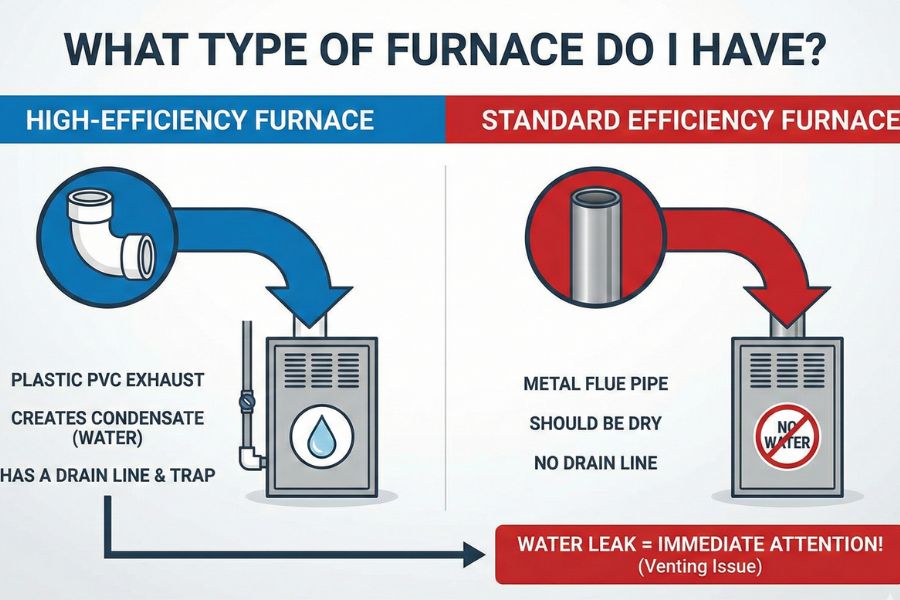
Identifying Your Furnace Type: High Efficiency vs. Standard
The troubleshooting steps change completely depending on the age and type of your machine. A furnace leaks water for very different reasons depending on its efficiency rating.
Why Does a High-Efficiency Furnace Leaks Water? (Condensation)
If your furnace was installed in the last 10 to 15 years, it is likely a high-efficiency condensing furnace (90% AFUE or higher). You can identify this easily by looking at the exhaust pipe.
| Feature | High-Efficiency Furnace | Standard Efficiency Furnace |
|---|---|---|
| Exhaust Pipe | White PVC (Plastic) | Metal Flue |
| Water Production | Normal (Creates condensation) | None (Should be dry) |
| Drainage | Has a drain line and trap | No drain line |
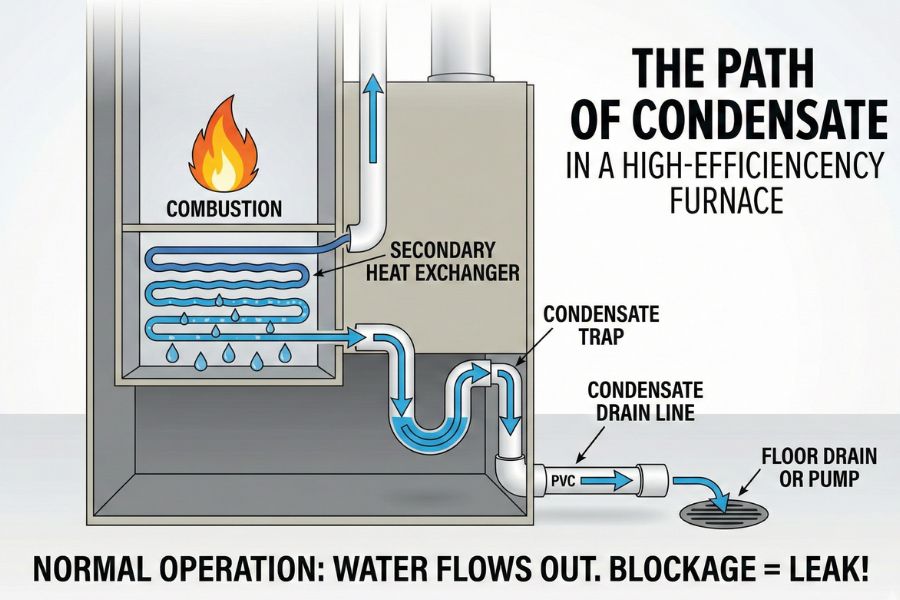
A high-efficiency furnace actually creates water as a byproduct of heating your home. It has two heat exchangers. It extracts so much heat from the combustion gas that the gas turns from steam into liquid (condensate). This water has to be drained away. When that drainage system fails, the furnace leaks water onto your floor.
Why Would a Standard Efficiency Furnace Leak Water? (The Metal Flue Issue)
If you have an older unit with a metal exhaust pipe, it should never produce water. If you see water pooling around a standard efficiency unit, it often indicates that the exhaust flue is improperly sized, causing gases to cool down too fast and condense inside the metal pipe. This is dangerous because it can lead to rust and carbon monoxide back-drafting. In this case, you need professional help immediately.
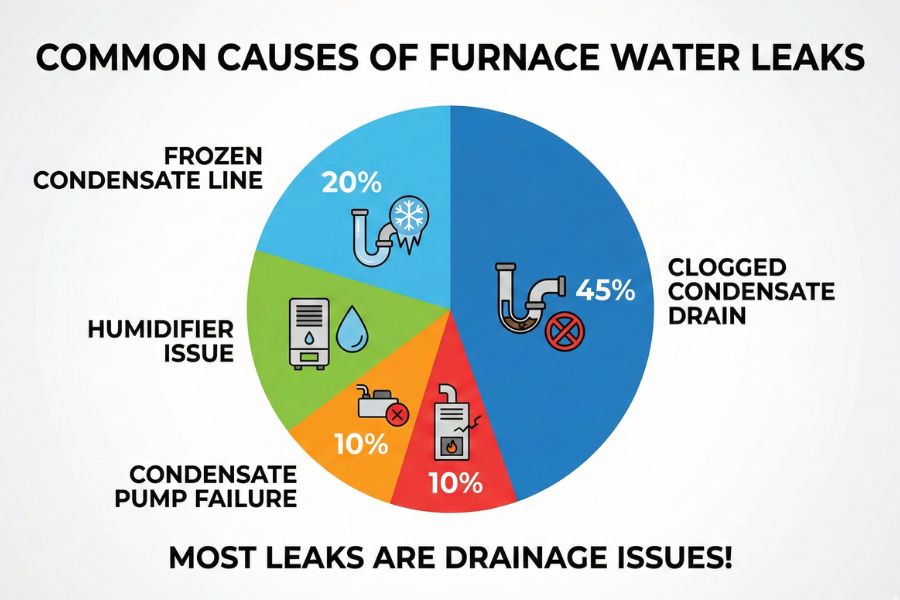
5 Common Reasons for Furnace Water Leaks
Assuming you have a modern high-efficiency unit (which is most common in the GTA), here are the five most likely culprits behind the puddle.
1. The Condensate Drain Line is Clogged or Frozen
This is the number one reason we see a furnace leak water. The condensate produced by your furnace flows through a PVC drain line to a floor drain or a pump. Over time, this pipe can get clogged with:
- Sludge and bacterial slime
- Dust and debris
- Mold growth
If the water cannot exit the pipe, it backs up into the furnace and spills over the internal collection box. Furthermore, during our freezing Canadian winters, if your condensate line runs along an uninsulated exterior wall or terminates outside, it can freeze solid. Ice acts like a cork, forcing the water backward into your basement.
We see this specific issue all the time in high-efficiency systems. Just last winter, our technicians responded to an emergency furnace repair call in Vaughan where a neglected, clogged condensate drain pipe had backed up and flooded a homeowner’s finished basement. Simply clearing that drain line during an annual tune-up would have saved them thousands in water damage.
2. Issues with the Condensate Pump
Not every basement has a floor drain conveniently located next to the HVAC unit. If yours does not, your system uses a condensate pump, a small white box usually sitting on the floor next to the furnace.
The pump collects the water and mechanically pushes it up and out through a vinyl tube. Like any mechanical device, these pumps can fail. If the float switch gets stuck or the motor burns out, the reservoir will overflow, resulting in a distinct puddle right next to the furnace.
3. Your Whole-Home Humidifier is Leaking
Sometimes the furnace takes the blame for a crime it didn’t commit. Many homes have a whole-home humidifier attached directly to the furnace ductwork. These units require a dedicated water line.
If the water feed tube is loose, the drain line for the humidifier is blocked, or the evaporator pad is old and calcified, water will leak down the side of the return air drop and pool at the base of the furnace. If you suspect this component is the issue, you may need to look into humidifier maintenance to stop the leak at its source.
4. The Heat Exchanger is Cracked
This is the scenario homeowners dread. In rare cases, a furnace leaks water because the secondary heat exchanger (the component that condenses the gas) has cracked or failed. When this happens, water leaks directly out of the collection header box.
This is a serious repair. A cracked heat exchanger can also leak carbon monoxide. If you see water leaking from the body of the furnace cabinet itself, rather than a pipe or pump, do not try to patch it. Call Heat Flow HVAC immediately.
5. A Clogged Air Filter Causing Frozen Coils
Believe it or not, a dirty air filter can cause a water leak. If the filter is so clogged that air cannot pass through, the evaporator coil (if you have AC) or the system itself can overheat or freeze up, depending on the airflow restriction.
If you have an AC coil sitting on top of your furnace and you run the fan, a restricted filter can cause that coil to freeze into a block of ice. When the system cycles off, that ice melts and drips straight down into the furnace and onto the floor.
DIY Troubleshooting: How to Fix a Leaking Furnace
Before you pick up the phone, there are a few simple checks you can perform. If the issue is a simple clog, you might be able to resolve the furnace’s water leak problem yourself.
Step 1: Check the Drain Hose
Look at the PVC pipe or flexible tubing coming from the furnace. Is it kinked? Is there visible gunk inside? If you have a Wet/Dry vac (Shop-Vac), you can put the hose over the end of the drain line (where it exits) and run it for a few seconds. This powerful suction can often pull out the sludge blockage.
Step 2: Inspect the Condensate Trap
Most high-efficiency furnaces have a “trap” (a U-shaped bend) that is designed to keep exhaust gases from escaping through the drain. This trap is a prime location for clogs. Some traps are removable and can be rinsed out in a sink with warm water.
Step 3: Test the Condensate Pump
If you have a pump, check if it has power. Is it plugged in? You can test it by slowly pouring a cup of water into the pump’s reservoir. If the water level rises and the pump doesn’t kick on to empty it, the pump is dead and needs replacement.
Step 4: Check the Humidifier Tap
Follow the small copper or plastic water line from your humidifier back to the water pipe. Ensure the connection is tight. If the leak is coming from the humidifier body, turn the dial to “Off” and close the water valve (usually a saddle valve) to stop the flow until it can be serviced.
When to Call a Professional for Furnace Water Leak Repair
While clearing a simple clog is manageable for many homeowners, messing with the internal components of a gas appliance carries risk. You should reach out for professional furnace repair services if you notice the following:
- The leak persists after cleaning the drain: This suggests a deeper internal blockage or a cracked part.
- Water is leaking from the vent pipe itself: This indicates an issue with the exhaust configuration.
- You have a standard efficiency furnace: As mentioned, these should not produce water. This is a red flag for venting issues.
- Electrical buzzing: If you hear buzzing or popping noises near the water, do not touch the unit.
Professional technicians have the tools to pressure test the lines, inspect the heat exchanger with cameras, and ensure that the water leak hasn’t corroded any gas valves or electrical boards.
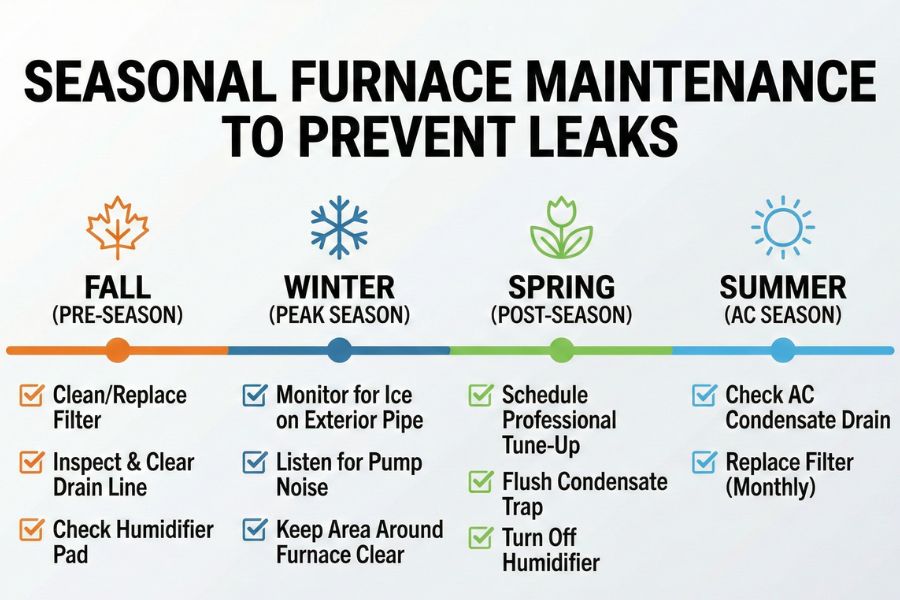
Keep Your Home Dry Without Any Furnace Water Leaks
Seeing water under your heating unit is stressful, but understanding the mechanics removes the fear. In most cases, a furnace leaking water is a drainage issue related to condensation. It is a messy problem, but usually a fixable one.
Regular maintenance is the best defense against these surprises. An annual tune-up ensures your drain lines are blown out, your traps are clear, and your humidifier is water-tight before the deep cold sets in. You can learn more about how system efficiency affects moisture management from sources like Natural Resources Canada regarding heating standards.
If you are staring at a puddle and aren’t sure where to start, Heat Flow HVAC is here to help. Don’t let a small leak turn into a rusted furnace or a flooded basement.
Frequently Asked Questions About Furnace Water Leaking
How much water should a furnace drain?
A high-efficiency furnace running comfortably in the winter can produce a surprising amount of condensate, anywhere from 5 to 10 gallons a day, depending on the size of the home and the runtime. This is why a blocked drain causes a flood so quickly.
Can I run my furnace if it is leaking water?
It depends on the severity. If it is a small drip from a drain line, you can likely keep it running while you wait for service, provided you keep a bucket or towels nearby. However, if the water is soaking the circuit board or pooling rapidly, you must shut it down to prevent electrical damage.
Why does my furnace leak when the AC is on?
If the leak happens during the summer or when the AC is running, the issue is likely the AC evaporator coil, not the furnace itself. The drain pan under the coil may be rusted out or blocked. While this is an AC issue, it manifests as water at the furnace base.